
Inventory management
Management of inventory levels is an important part of operating a production business. Inventory ties up capital, which may have better uses elsewhere. At the same time running out of critical input materials can have devastating effects. So what are good inventory levels and what tools are available to manage them?
Input vs Output
Firstly, there’s a big difference between high levels of inventory in inputs to our production versus the output products. Inputs are things we need and don’t want to run out of. Keeping a buffer, even a large buffer, can be prudent. Outputs on the other hand are things we’re looking to get rid of. Unless we have made agreements about scheduled deliveries, there are no downsides to emptying out the stores of outputs. Having a build-up of output products will tie up precious capital and, even worse, may obscure unfavourable changes in market conditions.
 We’re seemingly making a healthy profit on
our sales, but our inventory is growing. Other than tying up 260d of
capital, it may that demand is shrinking; perhaps we’re overestimating
the profitability of this production?
We’re seemingly making a healthy profit on
our sales, but our inventory is growing. Other than tying up 260d of
capital, it may that demand is shrinking; perhaps we’re overestimating
the profitability of this production?
If you see a build-up in output products, you may need to find new markets or dial back production. Or perhaps you can afford reduced profits, and aim to win market share by dropping your price.
Key ingredients
Moving our focus from having too much of something onto the things we worry about running out of, we’ll look at ways to ensure smooth operation of our industry.
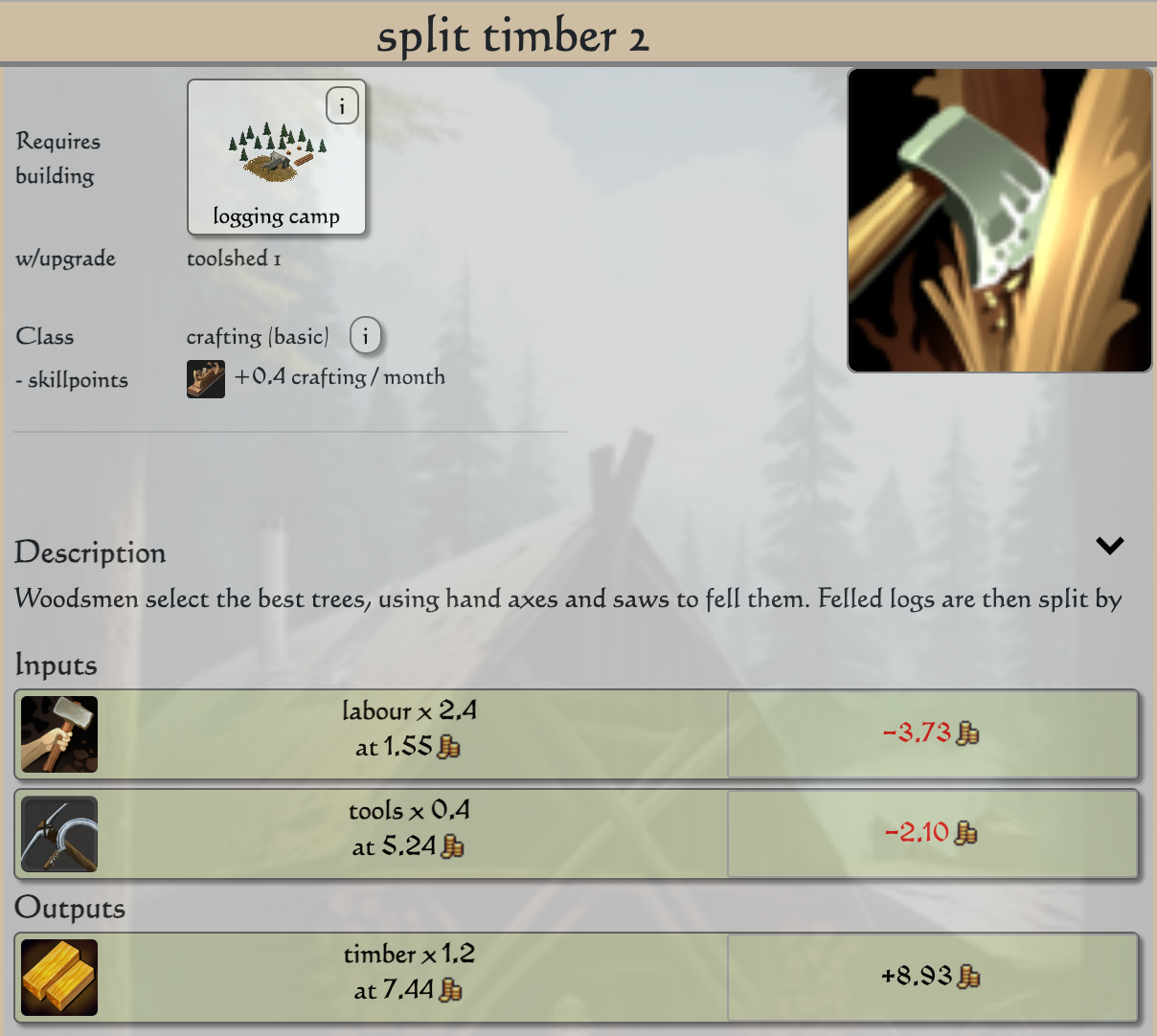
Like many production methods, split timber 2 relies on tools to offer increased efficiency over split timber 1, meaning it will usually be attractive to upgrade to this production method when possible.
However, we are now introducing a new dependency into our operation. We’ll often not produce our own tools but rely on purchases in the local market or imports. What happens if there’s a shortage or unexpected price increase?
 Our logging camp is suffering reduced
production due to a shortfall of tools,
Our logging camp is suffering reduced
production due to a shortfall of tools,
causing labour and carting to go unused and be wasted.
A healthy buffer
To avoid shortfall of important inputs, a straightforward solution is to keep a large buffer under our control. How large is a matter of priorities and risk appetite, as well as how reliable we judge the markets and suppliers we draw from to be. A casual player may decide to keep a stock of 100x the per-turn consumption of tools, thus having days of leeway even if the supply completely dries up.
Securing supply
The market uses unforgiving price-priority when assigning trade volume. If we’re getting outbid, we won’t get all, or even any, of the volume we’re seeking.
 Wishful thinking as a strategy. We may get
those 2 tools this turn, and maybe most turns, but this is by no means
guaranteed. If the price shoots back up our orders will go unfilled and
the buffer will start shrinking.
Wishful thinking as a strategy. We may get
those 2 tools this turn, and maybe most turns, but this is by no means
guaranteed. If the price shoots back up our orders will go unfilled and
the buffer will start shrinking.
Instead of entering a single fixed bid every turn we can use more advanced split-orders to get dynamic pricing and volume:
 Splitting the buy orders into 3 parts: 1)
pay up to 12d per unit to get our 2 tools if our stock is below 10. No
bid at this price is made if the stock is above 10, 2) pay up to 8d for
2 tools regardless of stock, 3) pay up to 6d for 1 extra unit to grow
our buffer when the price is low
Splitting the buy orders into 3 parts: 1)
pay up to 12d per unit to get our 2 tools if our stock is below 10. No
bid at this price is made if the stock is above 10, 2) pay up to 8d for
2 tools regardless of stock, 3) pay up to 6d for 1 extra unit to grow
our buffer when the price is low
Early warnings when trouble is brewing
In addition to automatically increasing the price we’re willing to pay when stock is running low, we can set a low stock alert. This will notify us of the issue so we can step in an manually survey the situation (assuming notifications to Discord are enabled).

Softening the blow
In addition to taking steps to avoid supply chain disruptions, we can also configure our production to soft-fail if an incident were to happen.

Like many production methods, split timber 2 has an option to fall back to a simpler variant (split timber 1) if there’s a shortfall of tools.
 Split timber 1, not as efficient as its more
complex variant, but without reliance on tools.
Split timber 1, not as efficient as its more
complex variant, but without reliance on tools.
The production method fallback triggers if production is reduced by more than 50% due to a shortage in one of the inputs and there exists a simpler variant of the production method which doesn’t rely on the input product in question. The building will then switch to the simpler production method, potentially reduce the production target to avoid increasing eg. labour consumption, and continue operating. Manual action is needed to re-upgrade production to the more complex production method.
Put it to the test
Head to Mercatorio.io to try out these techniques yourself in an economy simulator game with true markets and real competition.