
Mercatorio Introduction (updated)
This is an update of the original early-access introduction . In the meantime many other articles have been posted, offering more details on specific mechanics and elements of the game.
Mercatorio is an economy simulation game with true markets, where prices are set solely by supply and demand, which in turn is always against a counterparty (either another player, a bot, or other economic actor in the game).
The game is set in medieval times, developed by the independent game studio Hakk Games. It’s season based, with the current, third, season set to last 3 months. Each season wipes the slate clean to allow new entrants a shot at the leaderboard, but it’s fully possible to join the ongoing season as well.
The Mercatorio vision
Mercatorio has a dual vision, with the primary goal being to offer players a mercantile environment where prices and product availability are determined exclusively by the supply and demand of other market participants. The secondary goal is to model the production and logistics of the medieval era as historically accurate as possible.
Market mechanics
The production and logistics of Mercatorio will look familiar to players of other economy simulation games, like the great games of the Anno and Victoria series, with chains of production buildings and production methods refining raw materials into more valuable finished products, and ships or carts bringing raw materials in or shipping the finished products to their markets.
Where Mercatorio stands apart is in how players interact with each other in the marketplace. Both the availability of goods and the prices they trade for are solely dependent on the actions of the market participants, the supply versus the demand in a marketplace of sophisticated mercantile exchanges, where each product has a distinct price in every town.
 Trading on the market for timber in the town
of Unteraue
Trading on the market for timber in the town
of Unteraue
This means that shortages and gluts, and the wild price swings that accompany them will be directly felt by the players. Scale up production too fast, cleaning out the raw materials or flooding the market with your products, and the result can be punishing price changes eating all your profits. Anticipate and position yourself on the right side of a price move and watch streams of coin fill your business’ coffers.
The medieval era
Mercatorio aims to be a historically accurate and realistic simulation of the medieval economy. Yields and throughputs of production methods and buildings are being modeled after activities of the medieval era.
Some disclaimers here are in order here though. One is that the free market mechanics described above may not be exactly what the experience was like for medieval peasants. The other is that the focus in Mercatorio is on production, logistics and commerce, and you will find concepts like warfare and banditry relegated to the back in this game.
Although a lot of work has already been done to achieve the aim of historical accuracy, the ambitions of Mercatorio are high, and this is an area that will continue to improve.
Gameplay
Mercatorio has many dozens of buildings and products, a handful of ships and carts, and hundreds of distinct production methods. Typically there are several ways to produce the same item, using different inputs, or more complex steps, enabling players to make trade-offs between efficiency on one hand, and simplicity and robustness to supply disruptions on the other. Or perhaps find a substitute for a pricey raw material.
 Refining wrought iron into steel ingots is
one of the more complex production methods in the game, which in
addition to labour and raw materials (wrought iron and charcoal) uses ox
powered bellows and various tools. The bellows and tools are getting
worn down and replacement is factored into the production.
Refining wrought iron into steel ingots is
one of the more complex production methods in the game, which in
addition to labour and raw materials (wrought iron and charcoal) uses ox
powered bellows and various tools. The bellows and tools are getting
worn down and replacement is factored into the production.
Units vary for different products, for example is charcoal measured in quarts of 160 lbs while the ingots of steel are 2 lbs each. This will matter a lot when you’re looking to transport products over longer distances, and will influence where it makes sense to locate various industries.
Prospering in Mercatorio
With these tools at your disposal, a successful enterprise can take many forms. Will you invest in specialised means of large scale production, aiming to dominate the region within your narrow niche? Are the raw materials your industry requires available nearby or is a fleet of ships needed to bring it from across the world? Which of the other residents of your town will you lock horns with in competition and which can be trusted in cooperation? Or will you aim to build a more local and balanced business, catering to every need of the local population without much attention paid to the outside world? Local geography and natural conditions will play an important role, but so does the ever shifting landscape of the marketplace. If your reading of the situation is good, you are sure to be minting money in no time (figuratively, and perhaps, literally).
 Various raw material producing buildings in
the countryside. Some are ours (blue flags), while others are owned by
competing players or bots.
Various raw material producing buildings in
the countryside. Some are ours (blue flags), while others are owned by
competing players or bots.
Prestige and legacy
At the end of the day, financial success is only a means to an end. Prestige, and ultimately, leaving a legacy. Once the needs of your household are catered to, you can start using the wealth generated from your activities to do anything from throwing sumptuous parties to impress your peers, or undertaking grandiose construction projects that truly set you apart, to helping the poor by donating to the local church, all contributing to raising your standing and the prestige of your household.

The cathedral serves no economic purpose, but people do tend to take
notice when their neighbour puts on up.
Population and economic actors
The population is formed by households divided into three segments.
The gentry
The gentry are people of good standing, operating businesses, consuming luxuries and seeking prestige. These are the human players of Mercatorio as well as some number of bots building businesses like yours. If you want a style of gameplay more reminiscent of a city-builder game, or a game like Banished, you can choose an isolated town with few members in the gentry.
Commoners
The next segment is the common people and freemen of the town. They sell their labour on the market and use all the proceeds to purchase food and basic necessities. Being the most numerous economically active group, and providing the bulk of the labour powering almost all production, they are an important factor in Mercatorio. The better their needs are catered to, the more it allows them to dedicate their time to marketable labour. Additionally, towns where the commoners are well paid and fed will see an influx of migration and general growth in this segment of the population, and the crucial labour they offer.
Tenants
The last segment of the population are the tenants, either peasants living on leased land around the town, farming what they need to sustain themselves and are only marginally involved in the overall economy, or workers put up in boardinghouses, fed and clothed by their lord. Common for all tentants is that they pay rent in the form of labour. As your own prestige grows you will be able to lease out land and collect this payment, in the meantime you have to do some heavy lifting yourself and hire commoners for the rest.
The world of Mercatorio
The towns of Mercatorio are spread over a map consisting of 16 million tiles, each corresponding to a 200 by 200 metres plot, roughly sufficient to sustain a medieval peasant household (when the soil is fertile). Other than fertile soil and forestland there are a number of valuable resources, like iron or gold, spread over the map. Most towns will have access to some resources, but none are fully self-sufficient, meaning trade with those having access to other resources becomes an important part of the game. Sometimes this may be with nearby neighbouring towns, other times with those far away, requiring advanced trade ships to reach.
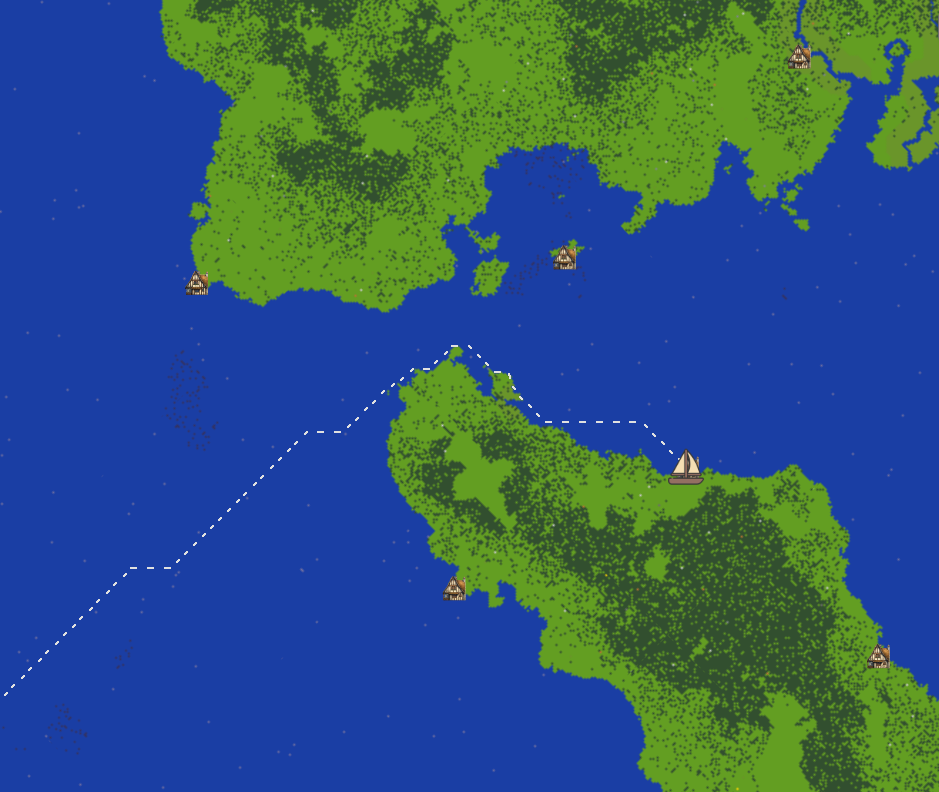 A ship on a journey to another town, where
you can trade manually or set up an automated trade route.
A ship on a journey to another town, where
you can trade manually or set up an automated trade route.
Roadmap
Mercatorio is an ambitious project and the game will be regularly updated, both to extend the existing game mechanics (more products, buildings, ships) and to open completely new gameplays (founding of manors outside the towns to reach new resources or utilize fertile lands, where you can escape the stress of the busy market-town and build your own little world — with a massive and complex global market to tap into when you desire). You can find the full roadmap and play the game here Mercatorio.io and follow updates on this blog or our Facebook page.